
How to Grow Herbs Indoors in Winter With Grow Lights
Learn how many hours of light herbs need, how far to hang grow lights, and which easy herbs to start with so you can harvest fresh leaves all winter.
 Save
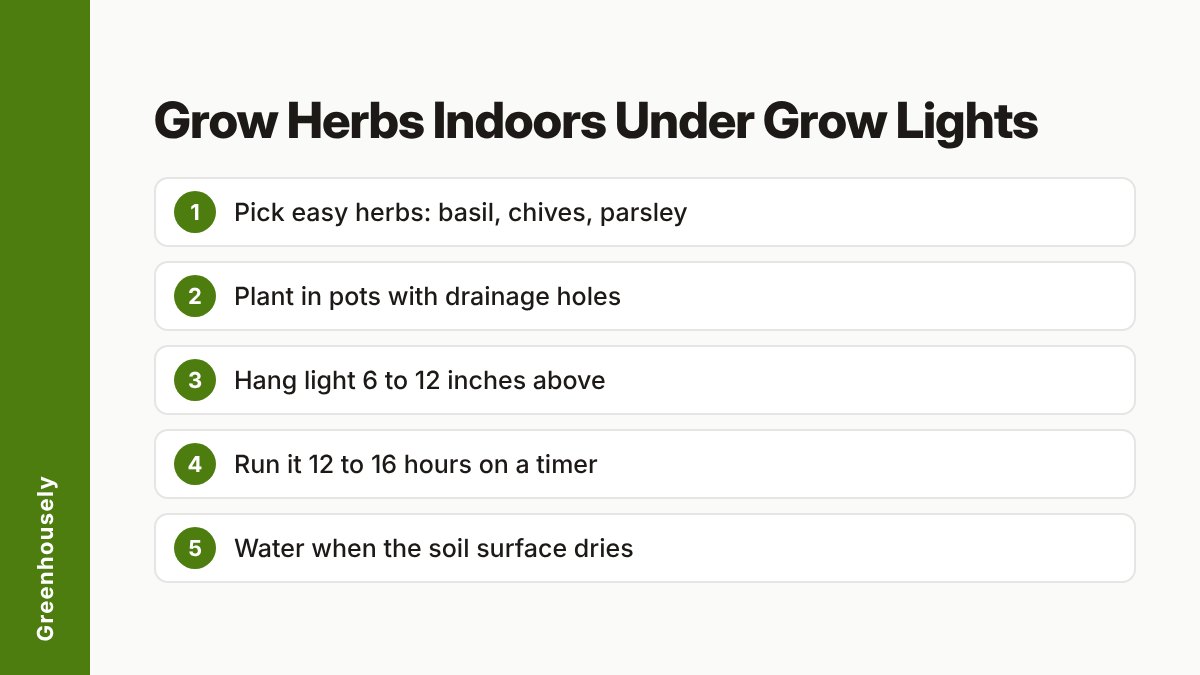
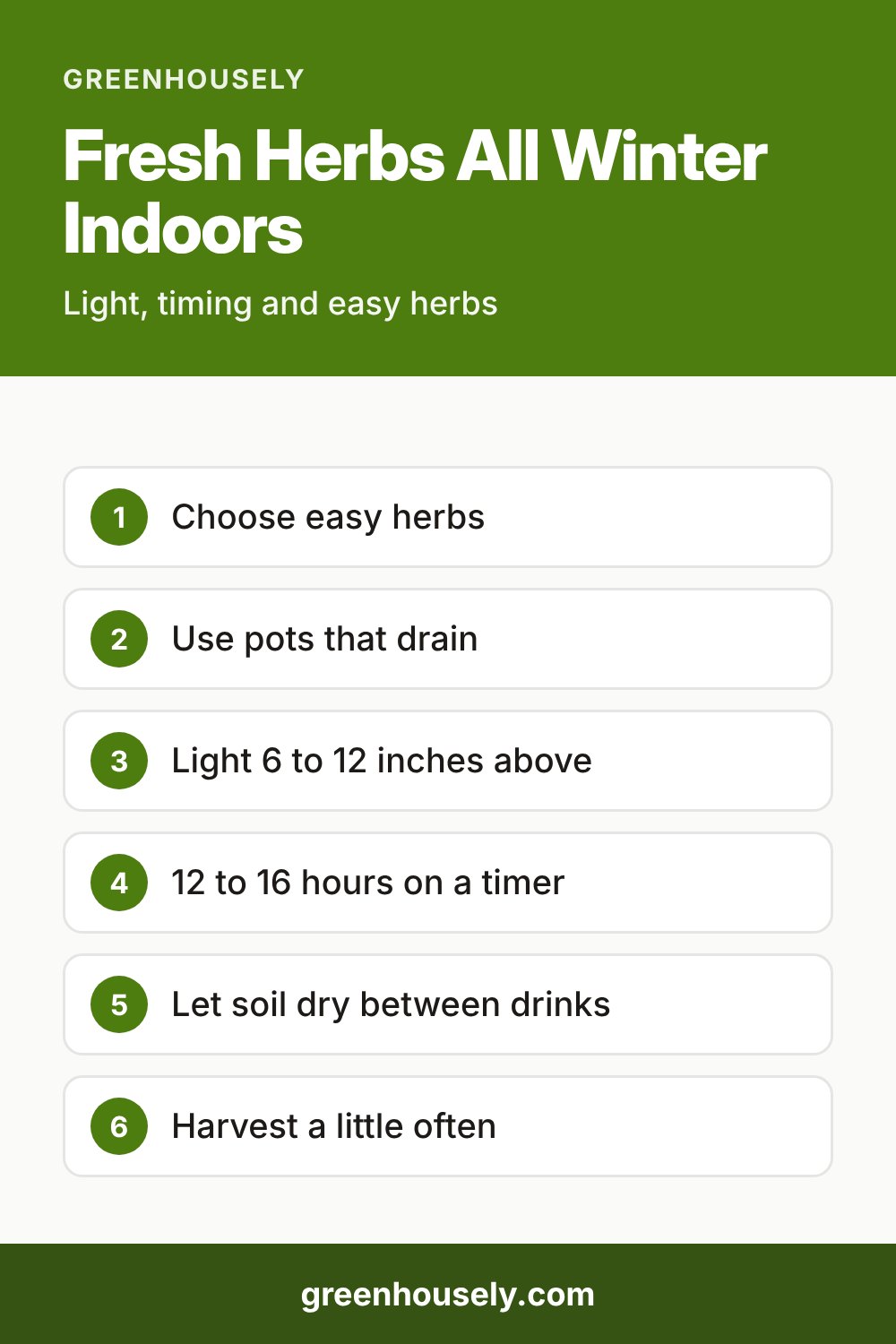
Most kitchen windows do not deliver enough winter light for herbs, but a simple grow light fixes that. Hang a full-spectrum light 6 to 12 inches above the leaves, run it 12 to 16 hours a day on a timer, and start with forgiving herbs like basil, chives, parsley and thyme.
Quick answer
Herbs are sun lovers. Extension sources say most need about 8 hours of direct light a day, though some manage on about 6 hours in winter. When a window cannot supply that, supplemental lighting closes the gap. The main settings to get right are below.
| Setting | What to aim for |
|---|---|
| Natural light | About 6 to 8 hours of bright light from a south-facing window |
| Grow light type | Full-spectrum, high-output fixture |
| Distance from leaves | About 6 to 12 inches (15 to 30 cm) |
| Daily light time | About 12 to 16 hours, on a timer |
| Room temperature | At or below 70°F (21°C), away from heaters |
| Fertilizer | Weak, water-soluble, and sparingly in winter |
Why herbs struggle indoors in winter
Short days, low sun angles and cloudy weather cut the light reaching a windowsill. Light shortage is the main limit on indoor herbs. When plants do not get enough, growth tends to be thin and stretched, and the leaves can be milder in flavor than outdoor-grown herbs. Basil is the exception noted by one extension page, which says it keeps its flavor indoors.
Heat is the second problem. Rooms that run warm and dry, or pots parked beside a radiator, stress plants. Keeping the room at or below 70°F (21°C) and moving plants away from direct heat sources is the advice from University of Illinois Extension.
What you need
- Containers with drainage holes. Choose pots sized to the plant. Oversized pots stay wet too long. Clay (terracotta) pots are porous and dry faster, which suits herbs.
- Quality potting mix. Use a well-drained potting mix, not garden topsoil.
- A grow light. A compact fluorescent bulb in a task light can serve a few plants. A plug-in 4-foot LED shop light suits a larger collection. Full-spectrum, high-output fixtures are the recommended choice.
- A timer. An inexpensive outlet timer keeps the light period consistent.
- A saucer or tray. It catches runoff so water does not damage furniture.
Because the setup involves mains electricity near water, keep cords and the timer off the floor and away from where you water, and use fixtures rated for the way you install them.
Step-by-step setup
- Pick your herbs. Choose from the easy list below. Give each species its own container, since their needs differ.
- Plant in drained pots. Fill with fresh potting mix and water in until moisture drains from the bottom, then empty the saucer.
- Choose the brightest spot. A south-facing window is best, and a bright east or west window can also work. Even with a bright window, add a light on dull days.
- Position the light. Place it about 6 to 12 inches above the leaves. Many fixtures can be hung from chains or set on an adjustable stand so you can raise them as plants grow.
- Set the timer. Run the light for about 12 to 16 hours a day. One Illinois guide puts it another way: plan on roughly 2 hours of supplemental light for every 1 hour of natural light you are missing, and describes 14 to 16 hours with two 40-watt cool white fluorescent tubes.
- Rotate the pots. In a bright window, turn containers every few days so growth stays even.
- Water when the surface dries. Let the soil dry somewhat between waterings, because most herbs dislike wet soil.
- Harvest regularly. Picking encourages new growth (see the harvest rules below).
Best herbs to grow indoors
| Group | Herbs | Notes |
|---|---|---|
| Easiest | Parsley, mint, chives, basil, oregano, cilantro (coriander), thyme | Good first choices under a light |
| Harder | Rosemary, sage, lemon balm, marjoram, chervil, bay laurel | Need more light and are more prone to pests such as spider mites |
Loose-leaf lettuce can share the same light setup and can be harvested at about 4 weeks, according to University of Illinois Extension.
Watering, humidity and feeding
Watering. Overwatering is a bigger risk than underwatering for most herbs. Check the soil before you water, and always use pots that drain.
Humidity. Heated homes can be dry. Clustering plants, with some space between them for air flow, helps. You can also stand pots on a tray of pebbles filled with water to just below the tops of the pebbles so the roots never sit in water.
Feeding. Herbs need less fertilizer than most container plants. Iowa State Extension suggests an all-purpose fertilizer at half or quarter strength and skipping winter. University of Illinois Extension suggests a water-soluble fertilizer every 2 weeks and warns that feeding more often can harm flavor and aroma. Since the advice differs, a weak dose at a modest interval is a cautious middle path, and slower growth in low light is a sign to hold back.
How to harvest without killing the plant
| Herb type | Examples | How to cut |
|---|---|---|
| Annual | Basil, chervil, parsley | Cut back hard, leaving 4 to 6 inches of stem. Replace with new seed after several harvests |
| Perennial | Chives, mint, oregano, thyme | Remove only the top third at a time |
Harvest as you cook. For recipe swaps, 1 tablespoon of fresh herbs roughly equals 1 teaspoon of dried.
Common mistakes
- Light too far away. A fixture hung well above the plants delivers little. Keep it within the 6 to 12 inch range.
- Light on all night or on a random schedule. Use a timer so the day length is steady.
- One big pot for everything. Mixed herbs have different water and light needs, so plant each species separately.
- Soggy soil. Oversized or undrained pots hold water and invite root problems.
- Placing plants against hot or cold glass or heaters. Keep them away from direct heat and from cold drafts.
- Heavy feeding. More fertilizer does not mean more flavor.
Troubleshooting quick guide
| Symptom | Likely cause | Fix |
|---|---|---|
| Tall, thin, pale growth | Not enough light | Lower the light toward 6 to 12 inches and extend the timer |
| Soil stays wet, leaves droop | Too much water or pot too big | Let soil dry, check drainage, move to a smaller pot |
| Fine webbing or speckled leaves | Spider mites | Isolate the plant and inspect nearby herbs |
| Weak flavor | Low light is common indoors | Add light and harvest regularly |
Safety notes
Switch the light off and unplug it before moving the fixture. Do not let water reach plugs, timers or power strips, and avoid covering a hot fixture. Follow the manufacturer’s instructions for your light.
Sources
 Save
Frequently asked questions
How many hours a day should grow lights be on for herbs?
Extension guidance suggests running full-spectrum lights on a timer for about 12 to 16 hours a day when they are the main light source. A timer keeps the schedule steady without daily effort.
How far should a grow light be from herbs?
A common recommendation is to hang the light roughly 6 to 12 inches (15 to 30 cm) above the leaves. Raise the fixture as the plants grow.
Which herbs are easiest to grow indoors?
Parsley, mint, chives, basil, oregano, cilantro (coriander) and thyme are listed as the easiest. Rosemary, sage and lemon balm are harder because they need more light.
Do indoor herbs need fertilizer in winter?
Advice varies by source. One extension page says to skip winter feeding, while another suggests a water-soluble fertilizer every two weeks, so use a weak dose and watch how the plants respond.